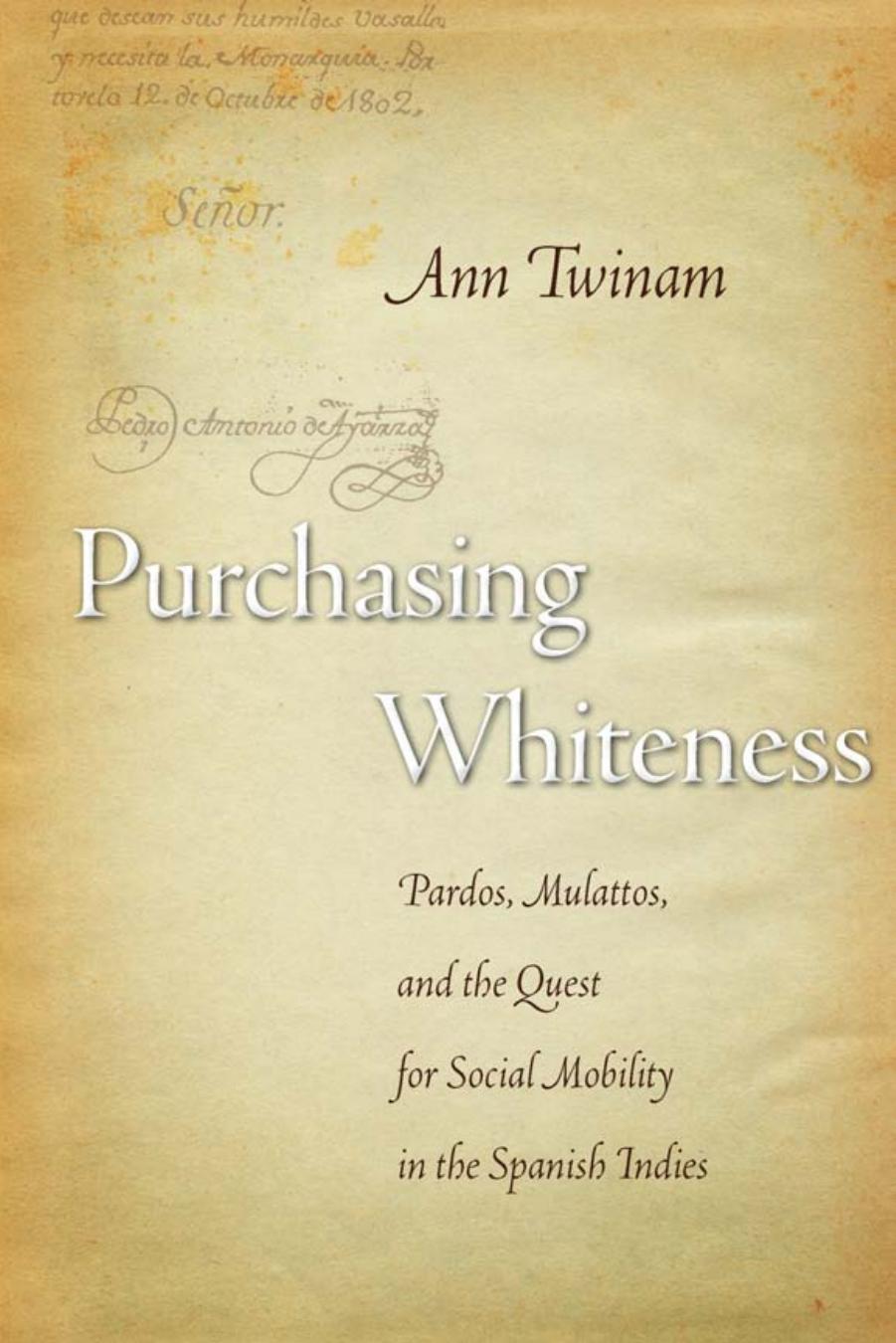
Purchasing Whiteness: Pardos, Mulattos, and the Quest for Social Mobility in the Spanish Indies by Ann Twinam
Author:Ann Twinam [Twinam, Ann]
Language: eng
Format: epub, pdf
Publisher: Stanford University Press
Published: 2015-01-27T22:00:00+00:00
CONCLUSIONS
By December 1796, the Landaetas and the Ayarzas still awaited word from Madrid. Four pardos—the two Valenzuela brothers, Diego Mexias Bejarano, and Angela Inés Rodríguez—had received the best news from the Council of the Indies. They had finally broken through centuries of discrimination; they had purchased a gracias al sacar that made them officially white. Given the newness of this option, what trends emerged during these formative two years?
Most evident was that the promulgation of the gracias al sacar had created administrative distress on both sides of the Atlantic. In Madrid, there was discord between the fiscals and the Cámara. Cistué y Coll’s first responses were negative: he denied the petition of the Ayarzas and refused to provide an opinion for the Valenzuelas. The Cámara promptly overruled him in both instances, sending to Bogotá for further information on the Ayarzas and issuing the first whitening gracias al sacar to the Valenzuelas. It remains unknown if Cistué y Coll provided a recommendation concerning the petition for Angela Inés Rodríguez or simply presented the case without an opinion to Camaristas: in any case they quickly approved it.
The fiscals began to share information on cases and to cooperate to reject petitioners. With Cistué y Coll absent, Posada y Soto reaffirmed his colleague’s previous negative ruling on the Ayarzas when further information arrived from Bogotá. As the Cámara hesitated, members began to search for precedents and delayed any decision. Given that the appearance of the whitening clauses was not the product of a deeply considered crown policy to promote whitening, it is not surprising that both the crown attorneys and the Cámara floundered, uncertain how to proceed.
Imperial officials on the other side of the Atlantic also evidenced hesitancy and dismay concerning the gracias al sacar. The governor of Maracaibo refused to publish the whitening clauses, sending pleas to his superiors in Caracas for further guidance. In Bogotá, Viceroy Ezpeleta worried that the whitening of pardos would overturn current law as well as open the gates for similar petitioners. When President Pedro Carbonell found that the Caracas city council seemed unaware of the gracias al sacar, even though he had sent them a copy, he provided another and awaited the inevitable explosion. The Caracas audiencia dithered on whether to publish the whitening clauses, fearing the consequences and decided to seek advice from higher officials.
The responses of the Caracas cabildo were in context and symptomatic of its traditional bellicose and ferocious defense of elite privilege. In April 1796, members scheduled a special meeting to protest, demanded that the governor suspend the clauses, and commissioned members to prepare a protest to send to Madrid. In November of that year, members denounced the whitening of Diego Mexias Bejarano and posted their voluminous complaints to Madrid.
Although the protests of the Caracas elites would eventually influence policy, some of their assertions only weakened their case. Particularly shocking was their unsubstantiated accusation that royal officials had added the whitening clauses to the gracias al sacar at the suggestion of the Caracas audiencia.
Download
Purchasing Whiteness: Pardos, Mulattos, and the Quest for Social Mobility in the Spanish Indies by Ann Twinam.pdf
This site does not store any files on its server. We only index and link to content provided by other sites. Please contact the content providers to delete copyright contents if any and email us, we'll remove relevant links or contents immediately.
| Anthropology | Archaeology |
| Philosophy | Politics & Government |
| Social Sciences | Sociology |
| Women's Studies |
Born to Run: by Christopher McDougall(7131)
The Leavers by Lisa Ko(6949)
iGen by Jean M. Twenge(5418)
Sapiens by Yuval Noah Harari(5374)
Spare by Prince Harry The Duke of Sussex(5201)
The Kite Runner by Khaled Hosseini(5185)
Machine Learning at Scale with H2O by Gregory Keys | David Whiting(4317)
Bullshit Jobs by David Graeber(4195)
Never by Ken Follett(3961)
Goodbye Paradise(3812)
Livewired by David Eagleman(3776)
Fairy Tale by Stephen King(3401)
A Dictionary of Sociology by Unknown(3086)
Harry Potter 4 - Harry Potter and The Goblet of Fire by J.K.Rowling(3076)
The Social Psychology of Inequality by Unknown(3037)
Will by Will Smith(2929)
The Club by A.L. Brooks(2927)
0041152001443424520 .pdf by Unknown(2849)
People of the Earth: An Introduction to World Prehistory by Dr. Brian Fagan & Nadia Durrani(2739)
